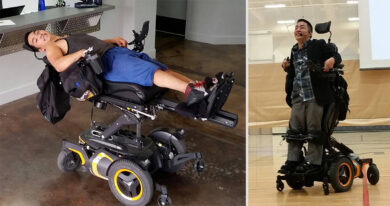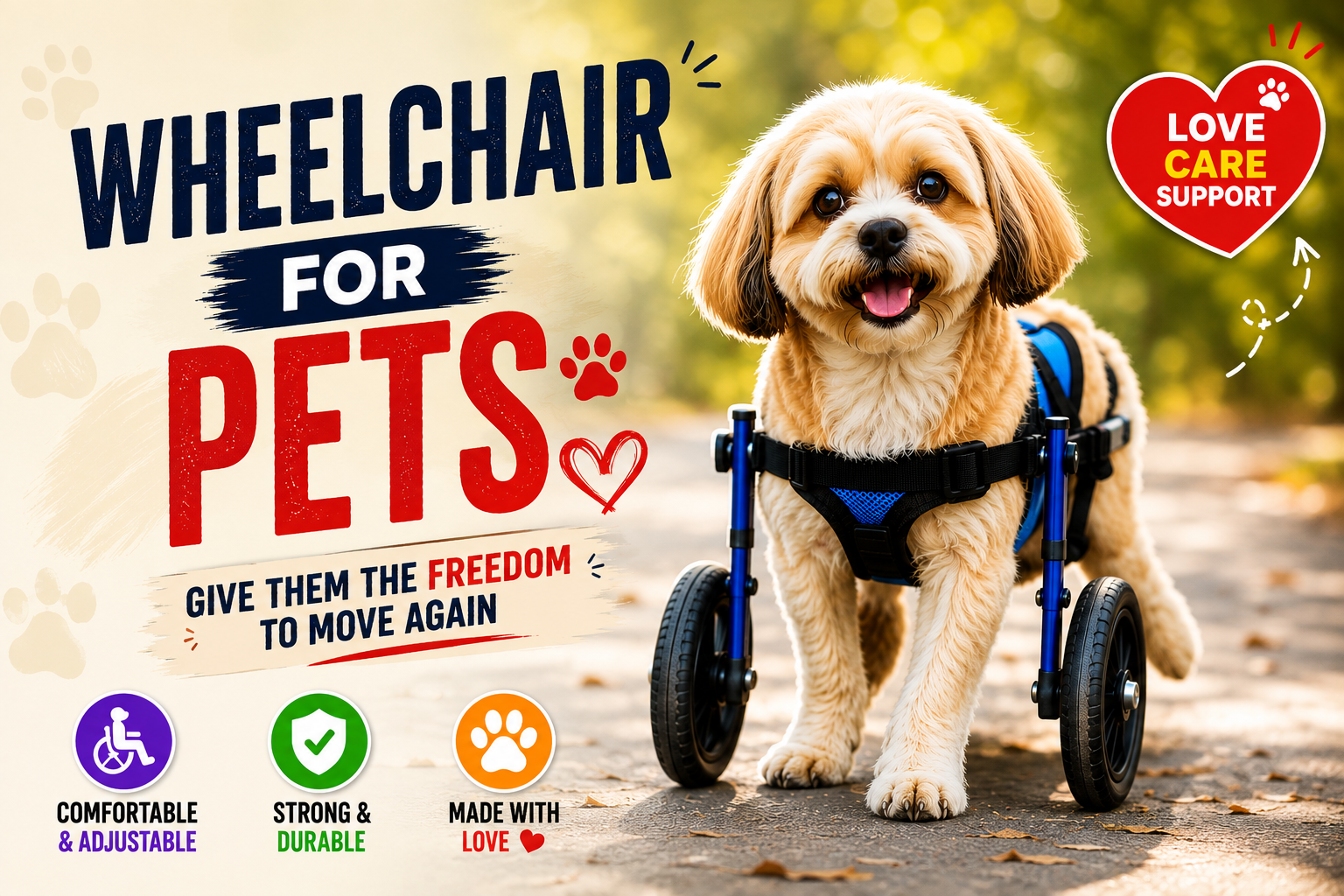

A customer came to us with a question we had not been asked before. Their dog had lost the use of both hind legs after a spinal injury. The vet had cleared him for movement. The family had done everything right. But the dog had stopped trying to get up.
They had seen our Esleh Victor wheelchair and asked a reasonable question: could it be adapted for a pet?
The honest first answer was no, not as it stands. A human wheelchair and a pet wheelchair solve two different physics problems. But the frame, the wheel assembly, and the build quality were all sound. So we rebuilt around them. This post walks through what actually changed, how we fit each unit, and how to know whether a wheelchair is the right call for your pet.
Why pets lose hind-leg mobility
Mobility loss in pets is rarely sudden and rarely mysterious. In most of the cases we see, it traces back to one of five causes.
Intervertebral disc disease (IVDD). Common in dachshunds, beagles, French bulldogs, and other long-backed breeds. A disc presses on the spinal cord and the rear legs weaken or go entirely.
Degenerative myelopathy. A progressive spinal cord condition seen most often in German shepherds, boxers, and retrievers. It is not painful, but it advances, and mobility support becomes necessary at a predictable point.
Trauma. Road accidents, falls, and fractures. Recovery varies widely depending on whether the spinal cord was involved.
Post-surgical recovery. After orthopedic or spinal surgery, controlled movement is often part of the recovery plan rather than something to avoid.
Age-related weakness. Arthritis and general muscle loss in senior pets. The legs still work, but not well enough to carry the weight.
The reason this matters is that the right wheelchair setup differs by cause. A dog with degenerative myelopathy needs a chair that can be adjusted as the condition progresses. A dog recovering from surgery may need one for eight weeks and never again. We ask about the diagnosis before we build, not out of formality, but because it changes the design.
Why a human wheelchair cannot simply be scaled down
This is the part most people are surprised by, so it is worth explaining properly.
A human wheelchair supports a seated body. Weight travels straight down through the hips into a horizontal seat, and the frame’s job is to hold that seat at a stable height. The center of gravity sits above the rear axle.
A pet’s body is horizontal. Weight is distributed along the length of the spine, carried at four points. When the hind legs stop working, the front legs take over the pulling and steering, and the wheelchair has to carry the back half of the animal without letting the spine sag or twist.
That single difference cascades into everything else:
- The support has to run along the body, not under a seat
- The rear wheels need to sit under the hips, not behind them, or the pet tips forward
- The harness has to hold the chest and abdomen without restricting breathing
- Height has to be set so the front legs stay in a natural standing posture, not stretched or crouched
- The whole assembly has to be light enough for an animal to pull with only its front legs
You cannot get there by shrinking a human chair. You get there by keeping the parts that are genuinely good and rebuilding the interface.
What we changed on the Esleh Victor
Here is what stayed and what was rebuilt.
Kept: the wheel assembly, the bearing quality, and the core frame tubing. These were already built for daily load-bearing use and there was no reason to compromise on them.
Rebuilt: the support structure. The seated support was replaced with a length-running frame that carries the pet’s rear body weight along the spine rather than at a single point.
Rebuilt: the harness system. A chest and abdominal harness with padded contact points, sized so it holds position during movement without pressure on the ribs or the bladder. Pressure over the abdomen is a real risk in pet mobility devices and it is the first thing we check at fitting.
Adjusted: frame height. Made adjustable across a range so the front legs stand naturally. This also allows the same unit to be raised or lowered as a growing dog matures, or as a progressive condition changes posture.
Adjusted: axle position. Moved forward so the rear wheels sit under the hip line. This is the single biggest determinant of whether a pet accepts the chair or fights it.
Added: rear leg stirrups (optional). For pets with legs that drag, soft slings hold the paws clear of the ground to prevent abrasion. For pets with partial function, we leave the legs free so they keep using what they have. Muscle you do not use is muscle you lose.
How we fit each unit
We do not sell this off a size chart. Two dogs of the same breed and the same weight can need different builds, because the measurement that matters most is not weight.
Before we build, we need:
- Body length measured from the base of the neck to the base of the tail
- Hip height from the ground to the top of the hip while standing or supported
- Chest girth measured just behind the front legs
- Weight
- Condition and diagnosis, including whether it is stable or progressive
- Remaining hind-leg function, meaning full loss, partial weakness, or intermittent
The last two are what a size chart cannot capture. A dog with 30 percent remaining function should not be lifted entirely off the ground, because that removes the exercise that preserves what is left. A dog with total loss needs the opposite.
Send these six things and we will tell you honestly whether a wheelchair will help, and whether ours is the right one.
Get a wheelchair built for your pet
Send us your pet’s body length, hip height, chest girth, weight, and diagnosis, and we will tell you whether a wheelchair will help before we quote you anything.
Call or WhatsApp: 9899599908
Email: sales@esleh.com
If you are not sure about the measurements, send a photo of your pet standing side-on with something for scale and we will walk you through it.